
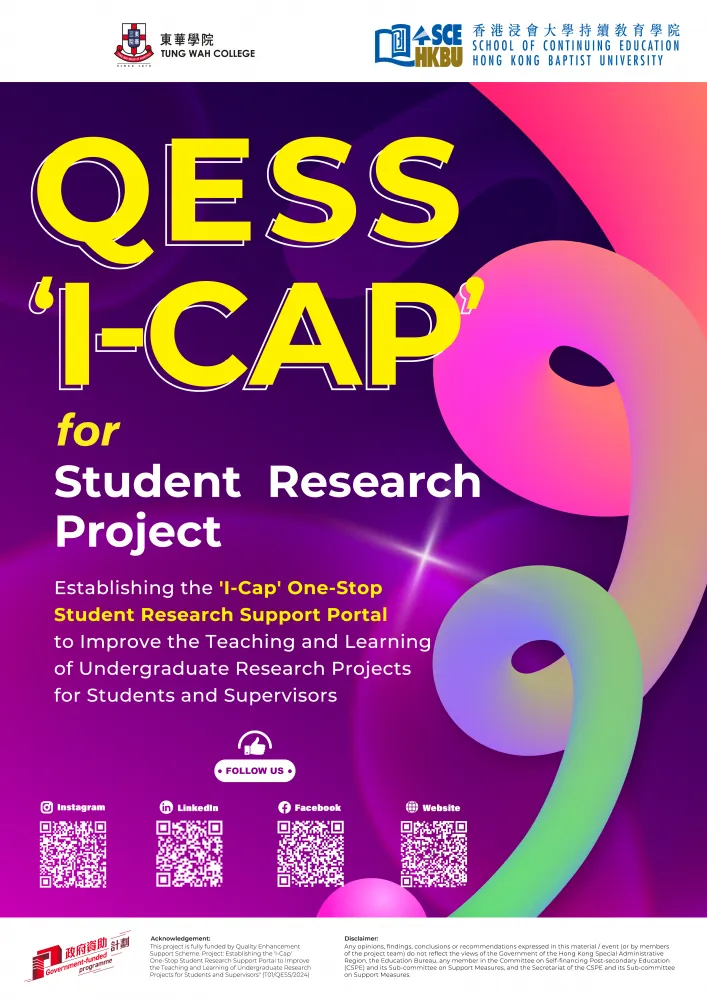
The QESS ‘I-Cap’ Project will develop and implement I-Cap, a unique one-stop student research support portal designed with an integrated–individualised–interactive–intelligent (4-Is) framework. The portal aims to enhance students’ research competencies while supporting supervisors throughout the teaching and learning process for undergraduate capstone (Cap) projects. Its goal is to improve the overall outcomes and experiences of both supervisors and students in conducting student research projects.
The overall project implementation team consists of eight members, supported by two dedicated project staff. Internally, the project is organized into a management committee, responsible for monitoring progress, and a working group, tasked with content development and production. Externally, a Project Evaluation Team comprising three professional experts will provide consultation on project progress, while an external expert review group will offer feedback and comments on the content.
The I-Cap portal will be developed from a ‘4-Is + Supervisor Support + Community’ framework to provide undergraduate supervisors and students with a rich and distinctive research teaching and learning experience. The ‘4-Is’ means integrated–individualised–interactive–intelligent. The Supervisor Support enables supervisors to find tailor-made resources to help them to mentor students at various levels. The community’s framework means the portal will provide a virtual forum in which students can discuss to foster a sense of community and provide social and emotional support.
There would be Six I-Cap research seminars organized on different research topics, with renowned research scholars invited to present. The seminars will be recorded to form part of the portal resources. They will provide insights into emergent trends and best practices in academia, enhancing the research competencies of students and inspiring supervisors.
Up to now, the QESS “I-Cap” project has organized four research seminars, attracting a total of 384 students and faculty members to participate in person. The seminar topics ranged from the initial exploration of research questions, to examining the transformative role of artificial intelligence in academic research, showcasing various AI tools and practical techniques, and further discussing the fundamental characteristics and philosophical foundations of qualitative research. They also clarified the distinctions between qualitative research and narrative approaches, while introducing common qualitative research designs. The diversity of seminar themes has provided students and research supervisors with multifaceted inspiration for student research.